_edited.png)
Iguana Land Adventure

If you find yourself trapped in the concrete routine of a busy life, and you just want to get away on a nature escape, you may be thinking of Brazil or Costa Rica. However, for a cheaper alternative, you should look no farther than Belize, on the west edge of the Caribbean.
Deep in the lush, river-fed hills and dense jungle of the Cayo District, just an hour west of our capital city, Belmopan, a prehistoric kingdom is quietly thriving even as you read this. While most travelers to Belize would head to the west for the Mayan temples, an entirely different kind of ancient resident awaits in the busy town of San Ignacio, one that is scaly, strictly vegetarian, and possesses a striking amount of personality, despite its dragon-like appearance.
Our destination was the San Ignacio Resort Hotel’s Green Iguana Conservation Project, a sanctuary dedicated to protecting one of Belize’s most misunderstood and endangered species. Stepping onto the resort grounds, along with my brother Andrew and my uncle Graham, who was visiting from Dallas, I couldn’t help but stop and observe the hotel itself. With its beautiful lobby, a chandelier hanging from the ceiling, a stairway to heaven, and a receptionist who made you feel welcomed, you would think this hotel was just another nice 5-star accommodation, but it has something unique just behind it. I went farther in to look around the lobby and spotted a photo of the late Queen Elizabeth II. She stayed at this specific resort all the way back in 1994 during her second visit to Belize, alongside her lifelong love, Prince Philip, Duke of Edinburgh.

Soon, it was time to go on the excursion, and our tour guide, a friendly guy named Brian, led us toward the massive, mesh-enclosed iguana habitat. The hotel began to fade as we were transported into a new dimension. Pool water gave way to river water, and the sounds of children playing were replaced by the sounds of wild animals that roam around the jungle. Ever since 1996, the San Ignacio Resort Hotel has been a prominent player in the efforts to protect the green iguana, as explained on the hotel’s website.
As Brian led us down to the San Iggy Hotel, as the iguana habitat is called, we looked around and took in the amazing green forests. You could smell the humid jungle air and hear the chirps of the keel-billed toucans flying around. Further below was a gigantic stream that I didn’t recognize, but Brian told us it was the Macal River. As we continued on, he educated us on many facts about the green iguana, the history of the conservation project, and why we must all work together to keep these magnificent creatures safe.
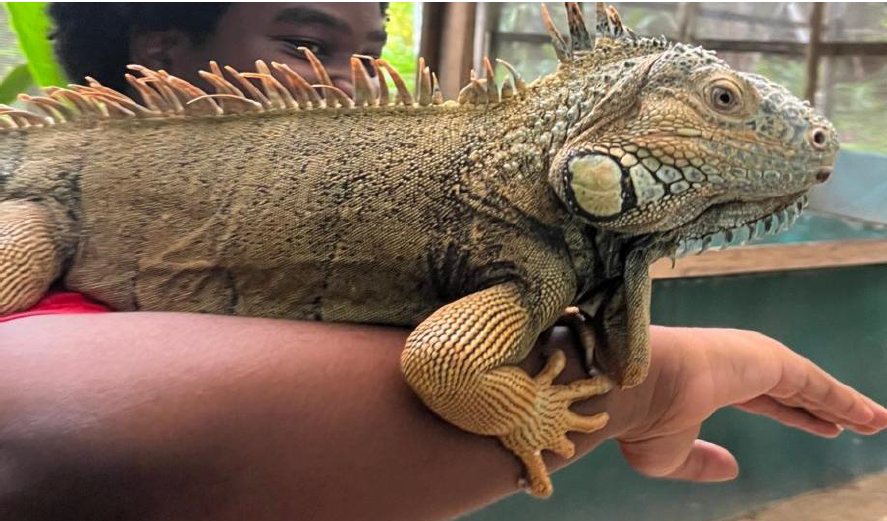
Soon, we reached the San Iggy Hotel. The group stepped into the enclosure, and there they were. Clinging effortlessly to vertical branches were several spectacular iguanas. However, one in particular captured our attention. It was gigantic, orange in color, and, when viewed from the right angle, seemed like the perfect model to cast in a Jurassic Park movie. His name is Alex, and, incredibly shocking, he had not one, not two, but three female iguanas accompanying him. Such a lucky bastard: being fed, relaxing and sleeping whenever he felt like it, and reigning over his jungle kingdom.
And lucky he was indeed, for his parents had been rescued from capture or death in the wild, and he was hatched with the help and motherly love of Brian. Continuing to explain about the endangered green iguana, Brian said: “If you’re a tourist you might be surprised, but we Belizeans call them “bamboo chicken,” as many people cook and eat them. Personally, I’ve never had bamboo chicken, and I don’t think green iguanas look appetizing. I asked Brian why Belizeans don’t eat the brown iguanas, or as we call them, “wish willies.” He said it’s because green iguanas consume a leafy diet, unlike wish willies, which are scavengers and can carry diseases.

Eventually, Brian asked if we would like to take pictures and hold Alex, and everyone said yes. I felt Alex’s tail. The scales were smooth, but the dorsal spines were as sharp as a razor. This is the defense mechanism of iguanas. When they feel threatened, they lash their tail at the perceived threat. Brian showed me how to get Alex to rest on my arm. Andrew and Uncle Graham held other iguanas by their bellies, and Brian took a group photo of all three of us.
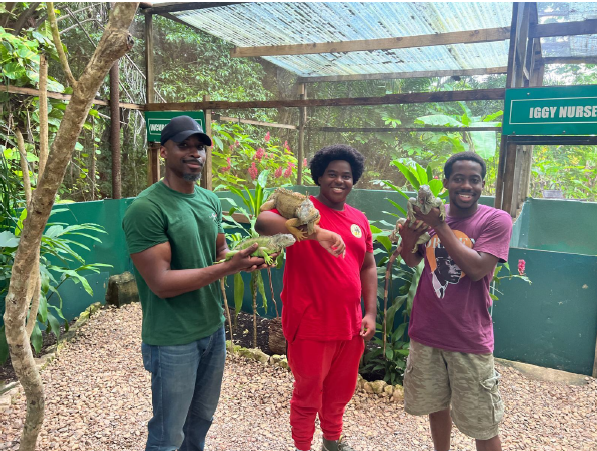
Brian then invited us into the nursery. You could certainly say Alex had done his part for the future of his kind in Belize because that nursery was full of babies. Heck, I’d argue that he alone could replenish Belize's green iguana population. As our group went farther in, the baby iguanas reminded us that these dinosaur-like creatures were, in fact, just lizards. They ran everywhere, even onto my brother’s shoulder and head.
As we trekked back up the hillside toward the hotel, the dense jungle canopy once again echoed with the rhythmic chirping of hidden keel-billed toucans, while leaf-cutter ants, or as we Belizeans call them, “wee wee” ants, roamed around doing their evening routine of carrying leaves to their queen in their neighboring kingdom. By then, the heavy weight of daily routines and digital screens had completely dissolved into the background. If you think about it, it’s rare to find a place that so effortlessly bridges the gap between modern luxury and raw, ancient wilderness. The resort offers a true pocket of sanctuary for any traveler navigating this chaotic world we live in.
Looking back at the mesh enclosure one last time as we departed, I thought of Alex, the sanctuary’s undisputed alpha male, lounging lazily on a high branch surrounded by his harem of female iguanas. Just basking in the sun and enjoying a steady supply of fresh leaves without a single care. He truly lives the ultimate reptilian dream.
And to you, traveler, if you ever find yourself in Belize, skip the standard tourist traps of the cayes, and come west. Step inside the iguana kingdom of Cayo to hand-feed the prehistoric reptiles. And discover firsthand what makes this conservation sanctuary the true, beating heart of The Jewel.

Wasani Castillo is an IT major at the University of Belize. He lives in Belmopan and enjoys coding and learning new things.


Comments